With prime planting conditions with us now, it’s time to begin filling in some of those gaps and planting out some of the garden beds that have been prepared over the cooler months. With a wetter than average Spring predicted we anticipate some fantastic new growth in new plantings this season.
While we’re all thinking about what to plant where, I thought we could profile a few plants here for various uses in the garden. Plants generally fall into one of the following categories: Trees, shrubs, grasses & sedges and ground-covers. There are a broad range of species that grow really well down here on the ‘Ninch and becoming familiar with your options is the first step to making decisions of what to plant where. We’ll focus on a couple of plants trees and shrubs here and follow up with profiles of some grasses/sedges and ground-covers in the October edition.
Just before we get started, it is worthwhile becoming familiar with the botanical name for plants rather than relying on the common name. Most nurseries will refer to their plants by the botanical name and you will also learn that the botanical name is somewhat descriptive of the plant.
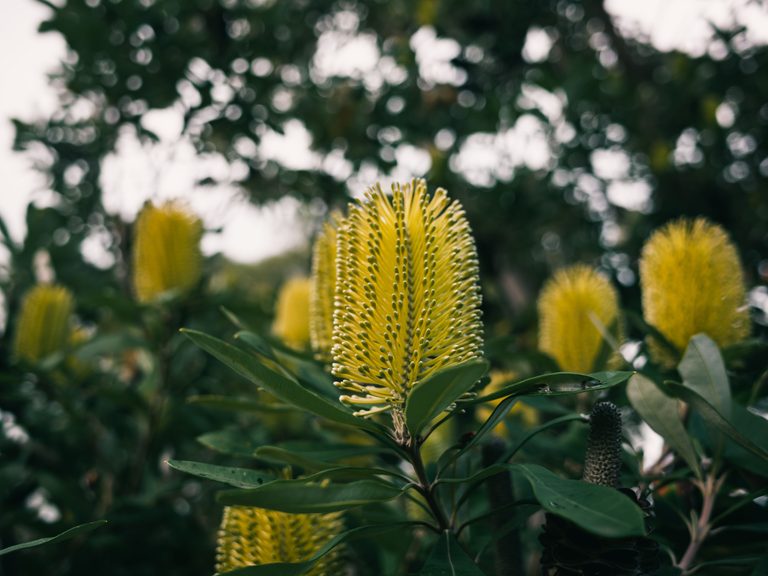
Two trees that grow particularly well on the southern part of the Peninsula are Banksia integrifolia (Coastal Banksia) and Melaleuca lanceolata (Moonah). Banksia integrifolia is a large tree up to 12m that can be used as a boundary/screening tree or as a feature tree. It is a popular choice for landscaping due to its attractive appearance and low maintenance requirements. Banksia integrifolia has large, serrated leaves and produces showy, yellow, cylindrical flower spikes in the autumn and winter, providing a bold and striking visual element to any landscape. Melaleuca lanceolata is a small to medium-sized tree that is indigenous to the Mornington Peninsula. It has narrow, lance-shaped leaves and produces showy, white or pink flowers in the winter and spring, providing a colourful and fragrant visual element to the garden. It is also drought-tolerant and can thrive in a range of growing conditions, making it a resilient and low-maintenance plant.
The couple of shrubs I have selected here are Correa alba (White Correa) and Dodonaea viscosa (Sticky hop-bush). Both of of these are found naturally on the Mornington Peninsula. Correa alba is a small to medium-sized shrub that can grow up to about 1.5 x 1.5m. It has oval-shaped leaves with white, star shaped flowers that bloom from autumn to spring, providing a delicate and sweet fragrance to any landscape. The birds and bees love them. Dodonaea viscosa is a large shrub up to about 3 x 2m that is popular in landscaping for its attractive foliage and beautiful red-winged flower structure. The leaves are thick, shiny and is the perfect plant for screening fences or for creating living fences.
The above plants will all add interest and beauty to your coastal garden and are equally hardy as they are attractive.
Happy gardening!